
LiONS LAIR partner McMaster Industry Liaison Office share things to consider when starting a business as a research-based company.

From Lab to Market: Transforming your Research into a Successful Business

Written by Gay Yuyitung – Executive Director, McMaster Industry Liaison Office

Launching a startup company requires commitment, dedication, and perseverance. As one of
Canada’s most research-intensive universities and a proud sponsor of Lions Lair, McMaster
University and our team of experts at McMaster’s Industry Liaison Office (MILO) know that
researchers often need support to transfer their discoveries from the lab to the market.

McMaster researchers disclose more than 80 inventions and creative works to the McMaster
Industry Liaison Office every year – and many of these inventions form the basis for new
startup companies that generate social and economic benefits for Canadians and the world.

Enedym, Empirica Therapeutics (acquired by Century Therapeutics), VoxNeuro, Altus Assessments, Elarex and Synmedix are just a few McMaster-affiliated startups that have seen incredible success in recent years. Cumulatively, McMaster startups have created over 500 highly skilled jobs in Canada and over 800 worldwide. They have generated over $20 million in annual revenue, raised over $570 million in financing, and have a market cap of $715 million.

Starting a company truly takes a village. Not only do you need to secure intellectual property rights to your inventions to create a competitive advantage, but you will also need to develop your technology into a product or service that is scalable and meets a customer need, as well as identify and acquire investors, suppliers, partners and customers to transform your innovation into a successful business. Our team at MILO is available to support researcher-based companies and has put together a guide to help all founders.

Things to Consider When Starting a Business

Diagram

Description automatically generated

Developing a Startup Business Plan

Entrepreneurs should build a thoughtful startup business plan that can help them develop their technology and attain sufficient revenue to sustain and grow their company. Having a business plan will come in handy when meeting with investors and pursuing funding. For early-stage startups, especially those in deep tech or emerging industries, a well-developed plan can be the difference between a compelling pitch and a missed opportunity.

While the business plan should be clear and structured, it is not meant to be static. Founders should revisit and refine the plan frequently, adjusting for new data, shifting market conditions, or lessons learned through customer discovery.

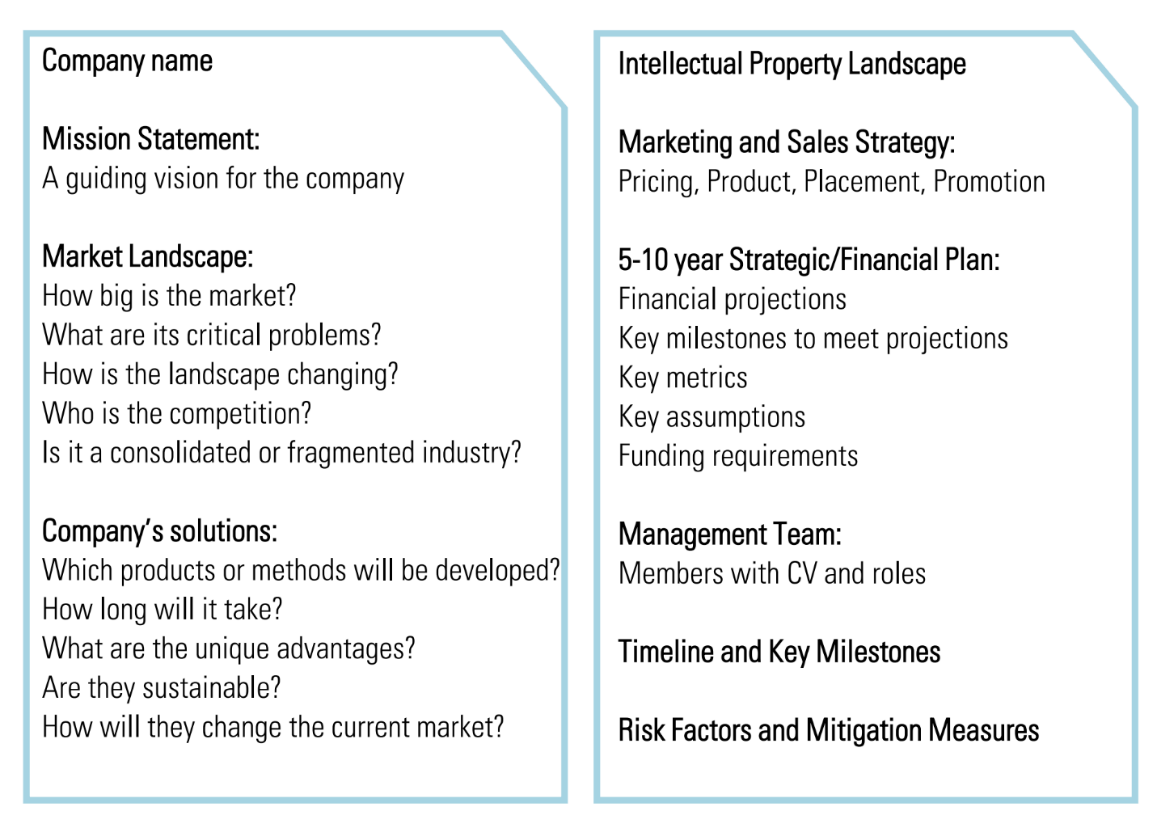
A business plan should be clear, concise and include the following:
  1. Company name and tagline
  2. Mission statement: A guiding vision for the company
  3. Market landscape:
    • Market size: How large is the addressable market (TAM/SAM/SOM)?
    • Core problems: What pressing challenges or inefficiencies exist?
    • Landscape shifts and trends: How is the market evolving (e.g. regulatory shifts, emerging technologies, consumer behavior)?
    • Competitor analysis: Who are the key players? What are their strengths, gaps, and strategic positions?
    • Market structure: Is this a consolidated industry dominated by a few, or a fragmented one open to disruption?
  4. Company’s solutions
    • Technology or product: What are you building? Is it software, hardware, biotech, a platform?
    • Development timeline: How long will it take to bring your solution to market?
    • Unique advantages: What sets your solution apart? (e.g. performance, cost, user experience, accessibility, integration potential)
    • Sustainability and longevity: Are your advantages sustainable over time, or easily replicated by competitors? What barriers to entry or moats exist (IP, data, partnerships, proprietary tech)?
    • Market impact: How does your product transform the market or create a new one?
  5. Intellectual Property (IP) landscape
    • IP Assets: What patents, trademarks, or trade secrets exist or are planned?
    • Freedom to Operate: Have you assessed legal risks related to IP infringement?
    • IP Roadmap: How will IP evolve alongside your product development?
  6. Marketing and sales strategy
    • Target customers: Who are your ideal users or buyers?
    • Sales channels: Direct sales? Partnerships? E-commerce?
    • Marketing plan – How will you build awareness and demand?
    • The 4 Ps of Marketing
      • Product: Key features and differentiators
      • Pricing: Pricing model (subscription, freemium, tiered, etc.)
      • Placement: Where will customers access the product?
      • Promotion: Outreach strategies (digital, PR, conferences, etc.)
  7. 5-10 year strategic/financial plan
    • Revenue model: How will the company generate income?
    • Financial projections: 3–5 year projections showing revenue, gross margin, EBITDA, cash flow, and runway
    • Key milestones to meet projects: Major technical, regulatory, or commercial goals
    • Key metrics: CAC (Customer Acquisition Cost), LTV (Lifetime Value), Monthly Recurring Revenue (MRR), Churn rate, Payback period, Gross margin, Burn multiple
    • Key assumptions: What are the forecasts based on?
    • Funding requirements: How much capital is needed, and how will it be allocated?
    • Cost structure: Fixed vs variable costs, burn rate
  8. Management team
    • Key members: Bios, relevant experience, LinkedIn links
    • Organizational structure: Who leads what, and how will hiring evolve?
    • Advisors: Technical, industry, or financial advisors that strengthen credibility
  9. Timeline and key milestones
    • 12–18 month roadmap: What happens first, and what must be achieved to raise the next round?
    • Dependencies: Are there regulatory approvals, pilots, or partnerships required?
    • KPIs: What will you track to measure traction and success?
  10. Risk factors and mitigation measures
    • Technical risks: What could delay or derail development?
    • Market risks: Could the market change faster than anticipated?
    • Operational risks: Talent, supply chain, scaling challenges
    • Mitigation plans: How will you proactively address these?

Pursuing investors and funding

The process of transforming a technology into a viable product typically requires significant investment from venture capitalists (VCs) or angel investors. VCs and angels are private investors who take on high risk ventures with goals of high returns. Return requirements vary based on industry and stage of funding, but many investors seek 10X their initial investment over 5 years.

Angel investors are typically high net worth individuals who have a personal interest in funding new companies. They are often willing to invest in earlier stages and with smaller amounts of money than VCs in exchange for equity. They can take passive or active roles in the startup.

Compared to angels, venture capitalists can invest larger amounts of money in a company, in turn receiving more equity. VCs also exercise control and bring experienced management talent to help guide and grow the company. Sometimes they invest in several rounds of funding and are part of a larger consortium of investors in the company.

Startups may also investigate and pursue funding from non-traditional sources such as government grants, bank loans, and crowdfunding (GoFundMe, Kickstarter, Indiegogo, etc).

Avoiding potential pitfalls

Creating a new company is a high-risk endeavour. Some common problems that can cause academic startups to fail are:
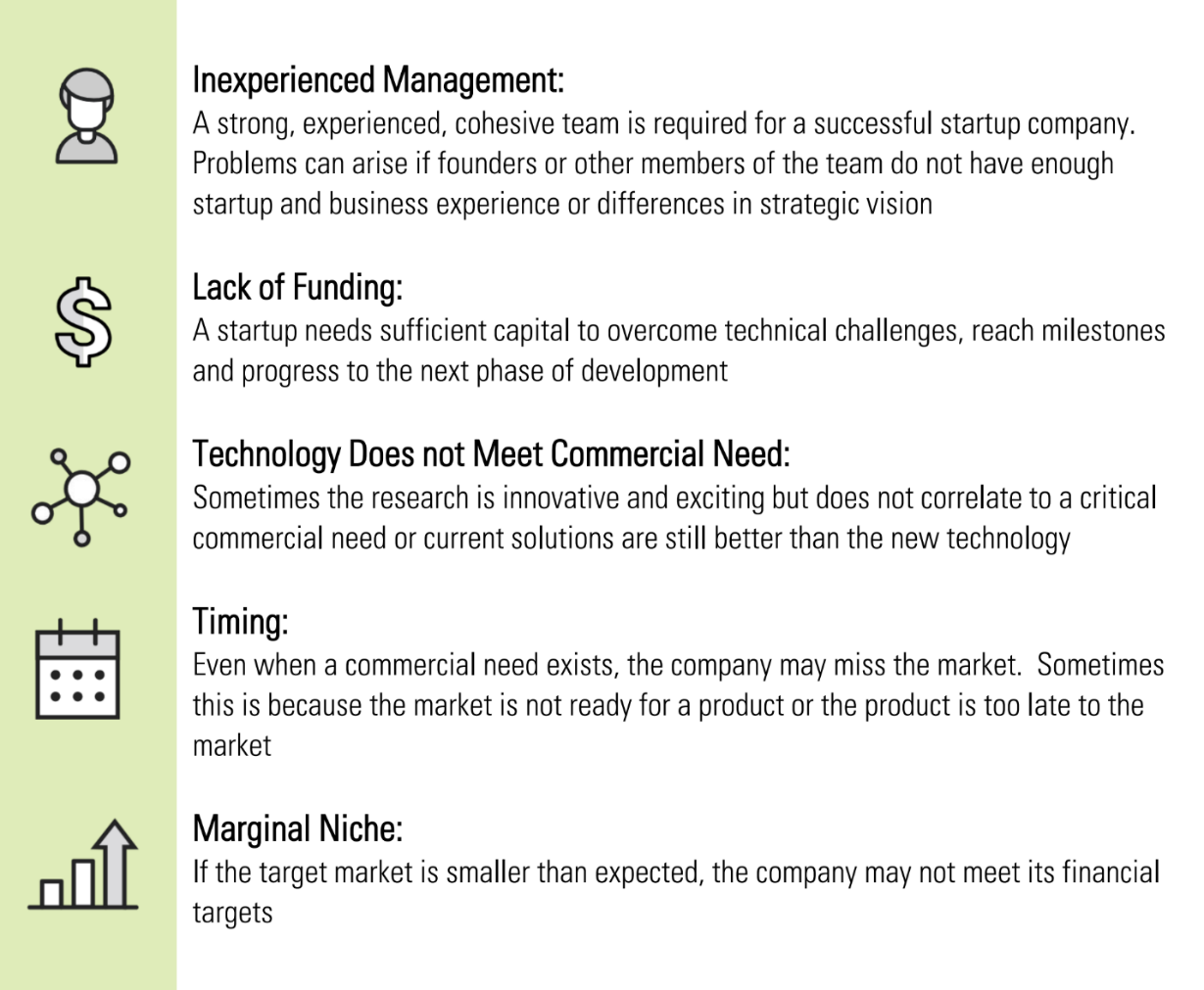
  • Inexperienced management: A strong, experienced, cohesive team is required for a successful startup company. Problems can arise if founders or other members of the team do not have enough startup and business experience or differences in strategic vision.
  • Lack of funding: A startup needs sufficient capital to overcome technical challenges, reach milestones and progress to the next phase of development.
  • Technology does not meet commercial need: Sometimes the research is innovative and exciting but does not correlate to a critical commercial need or current solutions are still better than the new technology.
  • Timing: Even when a commercial need exists the company may miss the market. Sometimes this is because the market is not ready for a product or the product is too late to the market.
  • Marginal niche: If the target market is smaller than expected, the company may not meet its financial targets.

We hope this guide can act as a starting point for commercializing your research. Read the full startup guide here and for more information and resources, please visit research.mcmaster.ca or contact MILO at [email protected] 

Share this article
Facebook
Twitter
LinkedIn
WhatsApp
Email
View All Categories

Featured iF Clients

Our website uses cookies to ensure you get the best experience. Learn more about the policy